PRE 14A: Preliminary proxy statement not related to a contested matter or merger/acquisition
Published on March 3, 2026
UNITED STATES
SECURITIES AND EXCHANGE COMMISSION
Washington, D.C. 20549
SCHEDULE 14A
Proxy Statement Pursuant to Section 14(a) of the Securities Exchange Act of 1934
(Amendment No. )
Filed by the Registrant ☒
Filed by a Party other than the Registrant ☐
Check the appropriate box:
|
☒ |
Preliminary Proxy Statement |
|
☐ |
Confidential, for Use of the Commission Only (as permitted by Rule 14a-6(e)(2)) |
|
☐ |
Definitive Proxy Statement |
|
☐ |
Definitive Additional Materials |
|
☐ |
Soliciting Material Pursuant to §240.14a-12 |
|
NextPlat Corp |
|
(Name of Registrant as Specified In Its Charter) |
|
(Name of Person(s) Filing Proxy Statement, if other than the Registrant) |
Payment of Filing Fee (Check the appropriate box):
|
☒ |
No fee required. |
|
☐ |
Fee paid previously with preliminary materials. |
|
☐ |
Fee computed on table in exhibit required by Item 25(b) per Exchange Act Rules 14a-6(i)(1) and 0-11. |

NextPlat Corp
400 Ansin Blvd, Suite A
Hallandale Beach, FL 33009
(305) 560-5381
To the Stockholders of NextPlat Corp:
You are cordially invited to attend the Special Meeting of Stockholders (the “Special Meeting”) of NextPlat Corp (the “Company”). The Special Meeting will be held virtually at 10:00 AM Eastern Daylight Time on April 6, 2026, or at such other time or such other date to which the meeting may be adjourned. The Special Meeting will be a virtual meeting to be held as a listen-only conference call. There will not be a physical meeting location.
We have prepared a proxy statement with detailed information about the matters that will be covered at the Special Meeting. We urge you to read the proxy statement carefully.
If you are a shareholder of record, you can participate and vote your shares in the Special Meeting by visiting www.proxyvote.com and entering the 12-digit control number included on your Proxy Card.
If you own your shares in “street name,” that is, through a brokerage account or in another nominee form, you must provide instructions to the broker or nominee as to how your shares should be voted. Your broker or nominee will usually provide you with the appropriate instruction forms at the time you receive the proxy materials. If you own your shares in this manner, you cannot vote at the Special Meeting unless you receive a proxy to do so from the broker or the nominee.
Your vote is very important, regardless of the number of shares of our voting securities that you own. Whether or not you expect to attend the virtual Special Meeting, please vote as promptly as possible to ensure your representation and the presence of a quorum at the Special Meeting. Only shareholders who held shares at the close of business on the record date, March 2, 2026, may vote at the Special Meeting. As an alternative to voting online during the Special Meeting, you may vote in advance of the Special Meeting, via the Internet, by telephone, or by signing, dating and returning the proxy card. If your shares are held in the name of a broker, trust, bank or other nominee, and you receive these materials through your broker or through another intermediary, please complete and return the materials in accordance with the instructions provided to you by such broker or other intermediary or contact your broker directly in order to obtain a proxy issued to you by your nominee holder to attend the meeting and vote in person. Failure to do so may result in your shares not being eligible to be voted by proxy at the Special Meeting.
We look forward to seeing you virtually on April 6, 2026.
|
Very truly yours,
NextPlat Corp |
|
By: |
|
||
|
David Phipps |
|||
|
Chief Executive Officer |
Important Notice Regarding the Availability of Proxy Materials
for the Special Stockholder Meeting to be Held on April 6, 2026:
Electronic Copies of the Proxy Statement and our 2024 Annual Report on Form 10-K are available at www.proxyvote.com.
NextPlat Corp
400 Ansin Blvd, Suite A
Hallandale Beach, FL 33009
(305) 560-5381
NOTICE OF SPECIAL MEETING OF STOCKHOLDERS
To Be Held April 6, 2026
TO THE STOCKHOLDERS OF NEXTPLAT CORP:
NOTICE IS HEREBY GIVEN that the Special Meeting of Stockholders (the “Special Meeting”) of NextPlat Corp (the “Company”) will be held on April 6, 2026, at 10:00 AM Eastern Daylight Time. The Special Meeting will be a virtual meeting to be held as a listen-only conference call by calling 1-888-700-7702 (toll free) or 1-929-566-8839 (international) or by internet at www.virtualshareholdermeeting.com/NXPL2026SM. There will not be a physical meeting location. If you encounter any difficulties while accessing the virtual meeting during the check-in or meeting time, a technical assistance phone number will be made available on the virtual meeting registration page 15 minutes prior to the start time of the meeting.
At the Special Meeting, the items of business to be voted on are:
|
● |
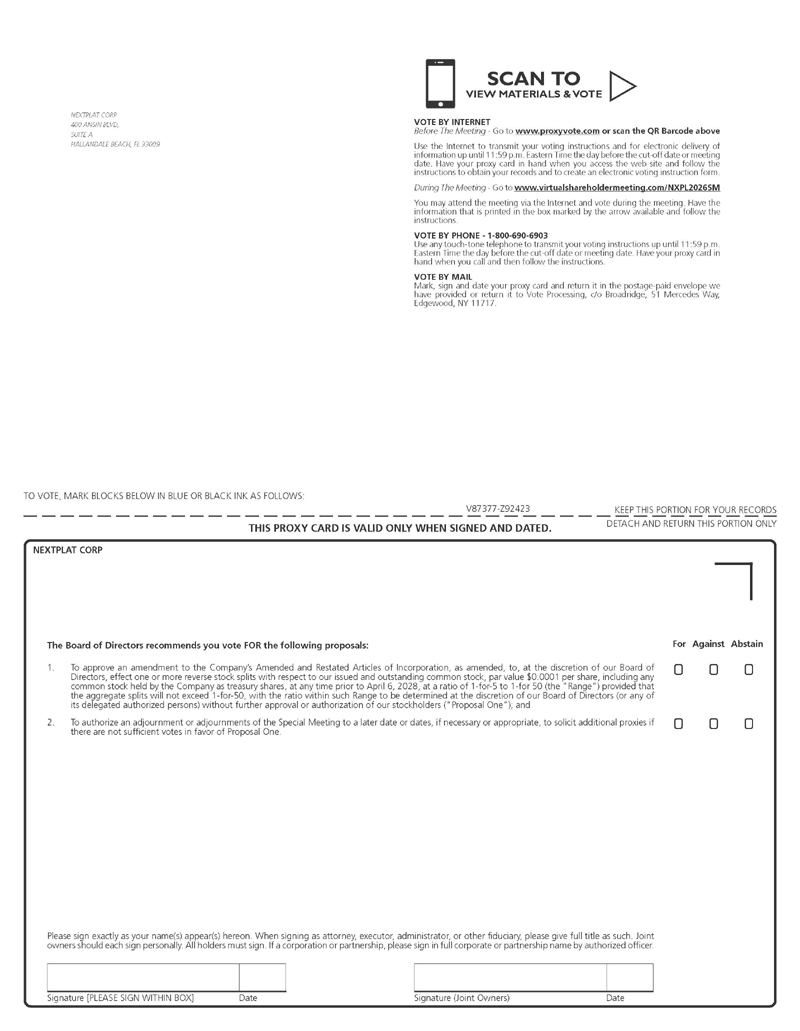
Proposal 1 — Reverse Stock Split Proposal: A proposal to approve an amendment to the Company’s Amended and Restated Articles of Incorporation, as amended (the “Articles of Incorporation”) to, at the discretion of our Board of Directors, effect one or more reverse stock splits (the “Reverse Stock Split”) with respect to our issued and outstanding common stock, par value $0.0001 per share (the “common stock”), including any common stock held by the Company as treasury shares, at any time prior to April 6, 2028, at a ratio of 1-for-5 to 1-for-50 (the “Range”) provided that the aggregate splits will not exceed 1-for-5, with the ratio within such Range to be determined at the discretion of our Board of Directors (or any of its delegated authorized persons) without further approval or authorization of our stockholders (such action is referred to herein as the “Reverse Stock Split” and such proposal is referred to herein as the “Reverse Stock Split Proposal” or “Proposal One”); and |
|
● |
Proposal 2 — Adjournment Proposal: A proposal to authorize an adjournment or adjournments of the Special Meeting to a later date or dates, if necessary or appropriate, to solicit additional proxies if there are not sufficient votes in favor of Proposal One (the “Adjournment Proposal” or “Proposal Two”). |
Only stockholders of record of the Company at the close of business on March 2, 2026 (the “Record Date”), are entitled to notice of and to vote at the Special Meeting or any adjournment or postponement thereof. A complete list of these stockholders will be open for the examination of any stockholder of record at the Company’s principal executive offices located at 400 Ansin Blvd, Suite A, Hallandale Beach, FL 33009 for a period of ten days prior to the Special Meeting. The list will also be available during the virtual Special Meeting for examination at www.virtualshareholdermeeting.com/NXPL2026SM. The Special Meeting may be adjourned or postponed from time to time without notice other than by announcement at the meeting.
Enclosed is the Proxy Statement containing detailed information concerning the Reverse Stock Split Proposal, Adjournment Proposal and the Special Meeting. Whether or not you plan to attend the Special Meeting, we urge you to read this material carefully and vote your shares.
Our proxy materials, including the Proxy Statement and Annual Report on Form 10-K for the year ended December 31, 2024, are available electronically at www.proxyvote.com.
YOUR VOTE IS IMPORTANT. Please read the proxy statement and the instructions on the proxy card and then, whether or not you plan to attend the Special Meeting, and no matter how many shares you own, please submit your proxy promptly by telephone or via the Internet, or by completing, dating and returning your proxy card in the envelope provided. This will not prevent you from voting at the Special Meeting. It will, however, help to assure a quorum and to avoid added proxy solicitation costs. You may revoke your proxy at any time before the vote is taken.
WHETHER OR NOT YOU PLAN TO ATTEND THE MEETING, PLEASE SIGN AND DATE THE ENCLOSED PROXY AND RETURN IT IN THE ENVELOPE PROVIDED.
|
By Order of the Board of Directors, |
|
|
NEXTPLAT CORP |
|
|
|
|
|
Hallandale Beach, FL |
David Phipps |
|
March [●], 2026 |
Chief Executive Officer |
| 1 | |
| 1 | |
| 1 | |
| 2 | |
| 2 | |
| 3 | |
| 3 | |
|
WHAT IF I HAVE TECHNICAL DIFFICULTIES OR TROUBLE ACCESSING THE VIRTUAL SPECIAL MEETING? |
3 |
| 3 | |
| 4 | |
| 4 | |
| 4 | |
| 5 | |
| 5 | |
| 6 | |
| 6 | |
| 6 | |
| 6 | |
| 7 | |
| 8 | |
| 20 | |
| 21 | |
| 21 | |
| 21 | |
| 22 |
NEXTPLAT CORP
PROXY STATEMENT
FOR
SPECIAL MEETING OF STOCKHOLDERS
TO BE HELD ON APRIL 6, 2026
INFORMATION ABOUT THE SPECIAL MEETING AND VOTING
WHY DID YOU SEND ME THIS PROXY STATEMENT?
This proxy statement and the enclosed proxy card are furnished in connection with the solicitation of proxies by the Board of Directors of NextPlat Corp, a Nevada corporation, for use at the Special Meeting of NextPlat’s stockholders to be held on April 6, 2026. The Special Meeting will be a virtual meeting to be held as a listen-only conference call by calling 1-888-700-7702 (toll free) or 1-929-566-8839 (international). There will not be a physical meeting location. If you encounter any difficulties while accessing the virtual meeting during the check-in or meeting time, a technical assistance phone number will be made available on the virtual meeting registration page 15 minutes prior to the start time of the meeting.
This proxy statement summarizes the information you need to make an informed vote on the proposals to be considered at the Special Meeting. However, you do not need to attend the Special Meeting to vote your shares. Instead, you may simply complete, sign and return the enclosed proxy card using the envelope provided. The terms “NextPlat,” “Company,” “we,” or “our” refer to NextPlat Corp.
WHAT PROPOSALS WILL BE ADDRESSED AT THE SPECIAL MEETING?
We will address the following proposals at the Special Meeting:
|
● |
Proposal 1 — Reverse Stock Split Proposal: A proposal to approve an amendment to the Company’s Amended and Restated Articles of Incorporation, as amended (the “Articles of Incorporation”) to, at the discretion of our Board of Directors, effect one or more reverse stock splits (the “Reverse Stock Split”) with respect to our issued and outstanding common stock, par value $0.0001 per share (the “common stock”), including any common stock held by the Company as treasury shares, at any time prior to April 6, 2028, at a ratio of 1-for-5 to 1-for-50 (the “Range”) provided that the aggregate splits will not exceed 1-for-50, with the ratio within such Range to be determined at the discretion of our Board of Directors (or any of its delegated authorized persons) without further approval or authorization of our stockholders (such action is referred to herein as the “Reverse Stock Split” and such proposal is referred to herein as the “Reverse Stock Split Proposal” or “Proposal One”); and |
|
● |
Proposal 2 — Adjournment Proposal: A proposal to authorize an adjournment or adjournments of the Special Meeting to a later date or dates, if necessary or appropriate, to solicit additional proxies if there are not sufficient votes in favor of Proposal One (the “Adjournment Proposal” or “Proposal Two”). |
WHO MAY ATTEND THE SPECIAL MEETING AND HOW TO ATTEND?
Our Board has fixed the close of business on March 2, 2026, as the record date for a determination of stockholders of NextPlat common stock entitled to notice of, and to vote at, the Special Meeting or any adjournment or postponement thereof (the “Record Date”). Record holders and beneficial owners may attend the Special Meeting (via phone call). Set forth below is a summary of the information you need to attend the virtual Special Meeting:
|
● |
Access an audio-only conference call by calling 1-888-700-7702 (toll free) or +1 929-566-8839 (International); |
|
● |
Instructions on how to attend and participate in the virtual Special Meeting, including how to demonstrate proof of stock ownership, are also available as follows: |
Stockholders of Record
|
● |
Stockholders of record as of the Record Date can attend the special meeting by accessing the live audio conference call at +1 888-700-7702 (toll free) or 1-929-566-8839 (international) and presenting the unique 12-digit control number on the proxy card. |
Beneficial Owners
|
● |
If you own your shares in “street name,” that is, through a brokerage account or in another nominee form, you must provide instructions to the broker or nominee as to how your shares should be voted. Your broker or nominee will usually provide you with the appropriate instruction forms at the time you receive the proxy materials. If you own your shares in this manner, you cannot vote in person at the Special Meeting unless you receive a proxy to do so from the broker or the nominee. |
HOW DO I PARTICIPATE IN AND VOTE AT THE SPECIAL MEETING?
If you were a shareholder of record at the close of business on the Record Date, you can participate and vote your shares in the Special Meeting by visiting www.virtualshareholdermeeting.com/NXPL2026SM and entering the 12-digit control number included on your Proxy Card.
If you own your shares in “street name,” that is, through a brokerage account or in another nominee form, you must provide instructions to the broker or nominee as to how your shares should be voted. Your broker or nominee will usually provide you with the appropriate instruction forms at the time you receive the proxy materials. If you own your shares in this manner, you cannot vote in person at the Special Meeting unless you receive a proxy to do so from the broker or the nominee.
Even if you plan to attend the Special Meeting, we recommend that you also vote by proxy as described below so that your vote will be counted if you later decide not to participate in the Special Meeting.
We will send this proxy statement, the attached Notice of Special Meeting and the enclosed proxy card on or about March 16, 2026 to all stockholders as of the Record Date. On the Record Date, we had [___] shares of issued and outstanding shares of NextPlat common stock entitled to vote at the Special Meeting.
HOW DO I VOTE WITHOUT PARTICIPATING IN THE SPECIAL MEETING?
Shareholders of record may vote without participating in the Special Meeting by any of the following means:
|
1. |
By Internet. The website address for Internet voting is www.proxyvote.com. |
|
2. |
By Phone. Call 1-800-690-6903. |
|
3. |
By Mail. Mark, date, sign and mail promptly the enclosed Proxy Card (a self-addressed envelope is provided for your convenience for mailing in the United States). |
If you vote by internet or phone, please do not mail your Proxy Card.
Because of possible delays with the mail, we recommend you use the Internet or Phone to vote. If you are a beneficial owner of shares held in street name, you can participate and vote at the meeting by obtaining a legal proxy from your nominee.
HOW DO I ACCESS THE PROXY MATERIALS OVER THE INTERNET?
Our proxy statement and our annual report on Form 10-K for the fiscal year ended December 31, 2024 (the “Annual Report”) are available online at www.proxyvote.com.
WHAT IF I HAVE TECHNICAL DIFFICULTIES OR TROUBLE ACCESSING THE VIRTUAL SPECIAL MEETING?
We will have technicians ready to assist you with any technical difficulties you may have in accessing the virtual Special Meeting. If you encounter any difficulties while accessing the virtual meeting during the check-in or meeting time, a technical assistance phone number will be made available on the virtual meeting registration page 15 minutes prior to the start time of the meeting.
Each share of common stock is entitled to one vote on each matter presented at the Special Meeting. Cumulative voting is not permitted.
WHY WOULD THE SPECIAL MEETING BE POSTPONED?
The Special Meeting will be postponed if a quorum is not present on April 6, 2026. The presence in person or by proxy of at least a majority of our common stock outstanding as of the Record Date will constitute a quorum and is required to transact business at the Special Meeting. If a quorum is not present, the Special Meeting may be adjourned until a quorum is obtained.
Abstentions and broker non-votes are treated as shares present or represented at the meeting but are not counted as votes cast. Shares held by brokers who do not have discretionary authority to vote on a particular matter and who have not received voting instructions from their customers are not counted or deemed to be present or represented for the purpose of determining whether stockholders have approved that matter, but they are counted as present for the purposes of determining the existence of a quorum at the Special Meeting.
Whether you plan to attend the Special Meeting or not, we urge you to submit your proxy even if you plan to attend the Special Meeting. If you vote by proxy, you may change your vote by submitting a later dated proxy before the deadline or by voting electronically at the Special Meeting.
If you properly fill in your proxy card and send it to us in time to vote, your proxy (one of the individuals named on your proxy card) will vote your shares as you have directed. If you sign the proxy card but do not make specific choices, your proxy will vote your shares as recommended by the Board as follows:
|
1. |
“FOR” the Reverse Stock Split Proposal. |
|
2. |
“FOR” the Adjournment Proposal. |
|
3. |
In their discretion, upon such other matters as may property come before the meeting. |
If any other matters are presented, your proxy will vote in accordance with his or her best judgment. At the time this proxy statement was printed, we knew of no matters that needed to be acted on at the Special Meeting other than those discussed in this proxy statement.
IF MY SHARES ARE HELD IN “STREET NAME” BY A BROKER, BANK OR OTHER AGENT, WILL MY BROKER, BANK OR OTHER NOMINEE VOTE MY SHARES FOR ME?
If your shares are held in “street name” in a stock brokerage account or by a broker, bank or other nominee, you must provide the record holder of your shares with instructions on how to vote your shares. Please follow the voting instructions provided by your broker, bank or other nominee. Please note that you may not vote shares held in “street name” by returning a proxy card directly to NextPlat or by voting in person (which would include presence at a virtual meeting) at the Special Meeting unless you provide a “legal proxy”, which you must obtain from your broker, bank or other agent.
Under the rules of Nasdaq, brokers who hold shares in “street name” for a beneficial owner of those shares typically have the authority to vote in their discretion on “routine” proposals when they have not received instructions from beneficial owners. However, brokers are not permitted to exercise their voting discretion with respect to the approval of matters that Nasdaq determines to be “non-routine” without specific instructions from the beneficial owner. Broker non-votes occur when a broker or nominee is not instructed by the beneficial owner of shares to vote on a particular proposal for which the broker does not have discretionary voting power.
If you give a proxy, you may revoke it at any time before it is exercised. You may revoke your proxy in three ways:
|
1. |
You may send in another proxy with a later date. |
|
2. |
You may notify us in writing (or if the stockholder is a corporation, under its corporate seal, by an officer or attorney of the corporation) at our principal executive offices before the Special Meeting that you are revoking your proxy. |
|
3. |
You may vote in person (which would include presence at the virtual meeting) at the Special Meeting. |
WHAT VOTE IS REQUIRED TO APPROVE EACH PROPOSAL?
Proposal 1: Reverse Stock Split.
Approval of this Proposal One requires the affirmative vote of a majority of the shares of our common stock that are entitled to vote that (i) are present in person or represented by proxy at the meeting and (ii) are voted “FOR” and “AGAINST” the proposal.
Proposal 2: Adjournment.
Approval of this Proposal Two requires the affirmative vote of a majority of the shares of our common stock that are entitled to vote that (i) are present in person or represented by proxy at the meeting and (ii) are voted “FOR” and “AGAINST” the proposal.
Other Business That Is Properly Brought Before the Special Meeting
If you do not give instructions to your bank or brokerage firm, it will nevertheless be entitled to vote your shares in its discretion on routine matters. However, absent your instructions, the record holder will not be permitted to vote your shares on a non-routine matter, which are referred to as “broker non-votes”, properly brought before the meeting. Broker non-votes (shares held by brokers that do not have discretionary authority to vote on the matter and have not received voting instructions from their clients) are not counted or deemed to be present or represented for the purpose of determining whether stockholders have approved that proposal but will be counted in determining whether there is a quorum present.
ARE THERE ANY RIGHTS OF APPRAISAL?
The Board of Directors is not proposing any action for which the laws of the State of Nevada, our Amended and Restated Articles of Incorporation or our Amended and Restated Bylaws provide the right of a stockholder to obtain appraisal of or payment for such stockholders’ shares.
WHO BEARS THE COST OF SOLICITING PROXIES?
We will pay for the entire cost of soliciting proxies. In addition to solicitation by mail, our directors, our executive officers and certain of our employees may, without additional compensation, solicit proxies by mail, in person, by telephone or other electronic means or by means of press release or other public statements.
We may also reimburse brokerage firms, banks and other agents for the cost of forwarding our proxy materials to beneficial owners.
WHERE ARE NEXTPLAT’S PRINCIPAL EXECUTIVE OFFICES?
The principal executive offices of NextPlat Corp are located at 400 Ansin Blvd, Suite A, Hallandale Beach, FL 33009, and our telephone number is (305) 560-5381.
HOW CAN I OBTAIN ADDITIONAL INFORMATION ABOUT NEXTPLAT?
We are subject to the informational requirements of the Securities Exchange Act of 1934, as amended, which requires that we file reports, proxy statements and other information with the SEC. The SEC maintains a website that contains reports, proxy and information statements and other information regarding companies, including NextPlat Corp, that file electronically with the SEC. The SEC’s website address is www.sec.gov. In addition, our filings may be inspected and copied at the public reference facilities of the SEC located at 100 F Street, N.E. Washington, DC 20549.
STOCK OWNERSHIP OF CERTAIN BENEFICIAL OWNERS AND MANAGEMENT
The following table sets forth information, as of March 2, 2026, regarding beneficial ownership of our common stock by:
|
● |
each of our directors; |
|
● |
each of our named executive officers; |
|
● |
all directors and officers as a group; and |
|
● |
each person, or group of affiliated persons, known by us to beneficially own more than five percent of our shares of common stock. |
Beneficial ownership is determined according to the rules of the SEC and generally means that person has beneficial ownership of a security if he or she possesses sole or shared voting or investment power of that security and includes warrants and options that are currently exercisable or exercisable within 60 days. Each director or officer, as the case may be, has furnished us with information with respect to beneficial ownership. Except as otherwise indicated, we believe that the beneficial owners of common stock listed below, based on the information each of them has given to us, have sole investment and voting power with respect to their shares, except where community property laws may apply. Except as otherwise noted below, the address for each person or entity listed in the table is c/o NextPlat Corp, 00 Ansin Blvd, Suite A, Hallandale Beach, FL 33009.
|
Name and address of beneficial owner |
Shares Beneficially Owned |
Percentage of Class (1) |
||||||
|
David Phipps |
1,001,621(2) | 3.7% | ||||||
|
Rodney Barreto |
3,533,443(3) | 12.5% | ||||||
|
Amanda Ferrio |
37,500 | * | ||||||
|
Douglas Ellenoff |
916,176(4) | 3.3% | ||||||
|
Hector Delgado |
84,710(5) | * | ||||||
|
Anthony Armas |
101,154 | * | ||||||
|
Lauren Sturges Fernandez |
6,281,246(6) | 21.6% | ||||||
|
Directors and Officers as a group (7 persons) |
11,955,840 | 38.2% | ||||||
|
5% or greater stockholders |
||||||||
|
Frost Gamma Investments Trust |
3,428,571(7) | 12.7% | ||||||
|
Robert D. Keyser Jr. |
2,874,339(8) | 9.9% | ||||||
|
* |
Less than 1%. |
|
(1) |
Based on 26,976,014 shares of common stock outstanding as of March 2, 2026. |
|
(2) |
Represents (i) 671,788 shares of NextPlat Common Stock, (ii) options to purchase 301,333 shares of NextPlat Common Stock that are currently exercisable, and (iii) warrants to purchase 28,500 shares of NextPlat Common Stock that are currently exercisable. |
|
(3) |
Represents (i) 2,260,784 shares of NextPlat Common Stock, (ii) options to purchase 186,945 shares of NextPlat Common Stock that are currently exercisable, and (iii) warrants to purchase 1,085,714 shares of NextPlat Common Stock that are currently exercisable. Includes shares of NextPlat Common Stock and Warrants held indirectly through RLB Market Investments, LLC. Mr. Barreto is owner and manager of RLB Market Investments, LLC. |
|
(4) |
Represents (i) 166,176 shares of NextPlat Common Stock and (ii) options to purchase 750,000 shares of NextPlat Common Stock that are currently exercisable. |
|
(5) |
Represents (i) 54,599 shares of NextPlat Common Stock and (ii) options to purchase 30,111 shares of NextPlat Common Stock that are currently exercisable. |
|
(6) |
Represents (i) 3,966,850 shares of NextPlat Common stock, including 2,990,252 shares of NextPlat Common Stock held by eAperion Partners, LLC, (ii) options to purchase 578,682 shares of NextPlat Common Stock that are currently exercisable, (iii) Warrants to purchase 1,685,714 shares of NextPlat Common Stock that are currently exercisable, including 1,085,714 Warrants owned by eAperion Partners, LLC, (iv) 25,000 shares of NextPlat Common Stock owned directly, and (v) options to purchase up to 25,000 shares of NextPlat Common Stock owned directly. The shares described in clauses (i) through (iii) are held by the estate of Charles M. Fernandez (the “Estate”), of which Ms. Fernandez serves as executor, and may be deemed to be beneficially owned by Ms. Fernandez by virtue of her role as executor of the Estate. The Estate is the owner and manager of eApeiron Partners, LLC. |
|
(7) |
The address of the beneficial owners is c/o Gamma Investment Trust, 4400 Biscayne Blvd, Suite 1500, Miami, Florida 33137. |
|
(8) |
[Represents (i) 176,093 shares of NextPlat Common Stock held directly by Robert D. Keyser, Jr., (ii) 588,167 shares of NextPlat Common Stock held by Sixth Borough Capital Fund, LP, (iii) 150,000 shares of NextPlat Common Stock held by Ark Financial Services Inc, (iv) 65,245 shares of NextPlat Common Stock held by Auxol Capital, LLC, and (v) warrants to purchase 1,918,766 shares of NextPlat Common Stock that are currently exercisable.] The address of the beneficial owners is 1515 N. Federal Highway, #300, Boca Raton, Florida 33432. |
PROPOSAL 1: REVERSE STOCK SPLIT
Our Articles of Incorporation currently authorizes the Company to issue a total of 800,000,000 shares of capital stock, consisting of 50,000,000 shares of common stock, $0.0001 par value per share. On February 26, 2026, subject to stockholder approval, our Board approved an amendment to the Articles of Incorporation to, at the discretion of our Board, effect one or more Reverse Stock Split of our common stock at a ratio of between 1-for-5 to 1-for-50, provided that the aggregate splits will not exceed a ratio of 1-for-50, including any shares held by the Company as treasury shares, at any time prior to or on April 6, 2028, with the exact ratio within such Range to be determined by our Board (or any of its delegated authorized persons) at its or their discretion without further approval or authorization of our stockholders. The primary goal of the Reverse Stock Split is to enable us to regain compliance with the Minimum Bid Price Requirement for continued listing on Nasdaq, as well as to increase the trading price of our common stock to enhance overall liquidity of the common stock by facilitating future financing and attracting new investors. We believe that the Range provides us with the most flexibility to achieve the desired results of the Reverse Stock Split. The Reverse Stock Split is not intended as, and will not have the effect of, a “going private transaction” covered by Rule 13e-3 promulgated under the Securities Exchange Act of 1934, as amended (the “Exchange Act”). The Reverse Stock Split is not intended to modify the rights of existing stockholders in any material respect.
If the Reverse Stock Split Proposal is approved by our stockholders and one or more Reverse Stock Split is effected, every five (5) to fifty (50) shares of our outstanding common stock held by each stockholder would be combined and reclassified into one share of common stock, with the exact ratio to be determined by the Board.
The Reverse Stock Split, if effected, will not change the number of authorized shares of our common stock or the par value of our common stock.
The actual timing for implementation of the Reverse Stock Split is expected to be at any time prior to April 6, 2028. However, notwithstanding approval of the Reverse Stock Split Proposal by our stockholders, the Board (or any of its delegated authorized persons) will have the sole authority to abandon the Reverse Stock Split and not amend our Articles of Incorporation if it determines between now and April 6, 2028 that not consummating the Reverse Stock Split would be in the best interests of the Company and its stockholders. If the Reverse Stock Split Proposal is approved by our stockholders, prior to amending the Articles of Incorporation and filing the Reverse Stock Split Articles of Incorporation Amendment (as defined below) with the Secretary of State for the State of Nevada, the Board (or any of its delegated authorized persons) will make a determination as to whether effecting the Reverse Stock Split is in the best interests of the Company and its stockholders in light of, among other things, the per share price of the common stock immediately prior to the Reverse Stock Split and the expected stability of the per share price of the common stock following the Reverse Stock Split. If the Board (or any of its delegated authorized persons) determines that it is in the best interests of the Company and its stockholders to effect the Reverse Stock Split, it will determine the ratio of the Reverse Stock Split. For additional information concerning the factors the Board will consider in deciding whether to effect the Reverse Stock Split, see “— Determination of the Reverse Stock Split Ratio” and “— Board Discretion to Effect the Reverse Stock Split.”
The text of the proposed amendment to our Articles of Incorporation to effect the Reverse Stock Split is included as Annex A to this Proxy Statement (the “Reverse Stock Split Articles of Incorporation Amendment”). If the Reverse Stock Split Proposal is approved by our stockholders, we will have the authority to file the Reverse Stock Split Articles of Incorporation Amendment with the Secretary of State of the State of Nevada, which will become effective upon its filing or the effective time set forth in the Reverse Stock Split Articles of Incorporation Amendment. The Board has determined that the amendment is advisable and in the best interests of the Company and its stockholders and has submitted the amendment for consideration by our stockholders at the Special Meeting.
Reasons for the Reverse Split and Factors to Consider
We are submitting this proposal to our stockholders for approval in order to regain compliance with the Minimum Bid Price Requirement for continued listing on Nasdaq, as well as to increase the trading price of our common stock to enhance overall liquidity of the common stock by facilitating future financing and attracting new investors.
Continued Listing Compliance
On [●], the closing bid price for the Company’s common stock listed on Nasdaq was $[●] and the Company’s common stock has been trading below $1.00 for more than thirty (30) consecutive trading days. The Company therefore is not in compliance with Nasdaq’s Minimum Bid Price requirement. Rectifying our bid price deficiency is necessary to allow the Company to maintain the listing of its securities on Nasdaq.
If the Company does not regain compliance with the Minimum Bid Price requirements by April 27, 2026, Nasdaq will notify the Company that its common stock is subject to delisting from the Nasdaq Capital Market.
The Reverse Stock Split Proposal, if passed, is intended to increase our stock price to an amount that we expect will allow our common stock to stay trading above the $1.00 minimum threshold in the long term. If the Reverse Stock Split is successful and if we can maintain a trading price above $1.00 for at least ten (10) consecutive trading days, then we expect to be able to regain compliance with the Minimum Bid Price requirement. Maintaining our Nasdaq listing as a publicly traded listed company has numerous benefits to the Company, including to our ability to procure more financing for ongoing operations, our ability to further our business strategy and our ability to attract more investor and business partner interest, among others.
Facilitate Future Financing
If we are able to remain listed as a publicly traded company listed on Nasdaq, we will be able to maintain our S-3 shelf eligibility, which greatly increases our access to the capital markets and other financing opportunities. Once a company has been delisted, its stock can trade OTC, but such companies will have significantly fewer opportunities to attract financing partners and less leverage to negotiate terms for such financing instruments and arrangements that are not overly burdensome or expensive to the Company.
Reinforce Market Stability and Attract More Investors
The Company believes the Reverse Stock Split Proposal will enable the Company to improve trading liquidity by increasing the price per share of our common stock, which could enable a broader range of institutions to invest. In particular, we believe many institutional traders are discouraged or prevented from investing in equity stocks with a price below a certain threshold, and having a stock price consistent with the stock prices contemplated by our Range will mitigate some of the risks that investors may associate with “penny-stock” trading levels, thereby potentially increasing marketability, trading volume and liquidity of our common stock. Additionally, because brokers’ commissions on transactions in low-priced stocks generally represent a higher percentage of the stock price than commissions on higher-priced stocks, the current average price per share of our common stock can result in individual stockholders paying transaction costs representing a higher percentage of their total share value than would be the case if the share price were substantially higher. Many institutional investors also have policies against holding equity securities of companies that are not traded on a national exchange, and the Reverse Stock Split Proposal, if passed and executed successfully, should allow us to maintain our Nasdaq listing status. Greater interest in our common stock should also promote greater liquidity for our stockholders. In addition, the proposal will help enable us to carry out our business plans with greater availability of shares, and help to regain compliance with the Minimum Bid Price requirement for continued listing on Nasdaq in the future.
What will happen if the Reverse Stock Split Proposal is not approved?
If we are unable to obtain approval of the Reverse Stock Split Proposal, and we are not otherwise able to increase our stock price to above $1.00 and maintain such price for at least ten (10) consecutive trading days before the Nasdaq Compliance Deadline, then we will be put into delisting proceedings by Nasdaq. If we are delisted, it would impede the liquidity of our common stock and limit our ability to carry out our business plan and strategies, which may cause the loss of significant business opportunities or prevent the commercialization of our technologies or completion of projects, any of which could adversely affect our financial performance, growth and ability to continue our operations. In addition, if we are unable to obtain approval of the Reverse Stock Split Proposal, we may consider strategic alternatives to strengthen our liquidity position and attempt to regain compliance with the Minimum Bid Price requirement before the Nasdaq Compliance Deadline. Due to our current financial condition, a number of these potential alternatives may not be feasible for us. These alternatives also involve significant uncertainties, potential significant delays, costs and other risks, and there can be no assurance that any of these alternatives will be available on acceptable terms, or at all, in the current market environment or in the foreseeable future.
Risks Associated with the Reverse Stock Split
The Reverse Stock Split may incentivize stockholders to sell their holdings of our common stock following the effectiveness of the Reverse Stock Split and depress the stock price, which could lead to our delisting from Nasdaq.
Similar with what has happened to our stock price in the past, if a significant number of shares of our common stock are sold into the market over a period of time, the increase in supply could lead to a depression of the stock price and it may be difficult to recover from such depression. Since our stock has been trading at significantly lower prices than what we expect the stock price will be immediately following the effectiveness of the Reverse Stock Split, some stockholders may take the opportunity to sell some or all of their shares of common stock following the effectiveness of the Reverse Stock Split. If this happens, our stock price could decrease quickly from the opening trading market price on the day of effectiveness of the Reverse Stock Split. If we are not successful in mitigating the volatility to our stock price following that date and over time, then we may not recognize any of the intended benefits of completing the Reverse Stock Split. If the stock price dips below $1.00 again following the completion of the Reverse Stock Split at any point in the ten trading days following the effectiveness of the Reverse Stock Split, then we will be subject to delisting from Nasdaq. Even if we are able to maintain a stock price above $1.00 for ten (10) trading days following the effectiveness of the Reverse Stock Split (or some longer period as Nasdaq may designate at their discretion), if the Company falls out of compliance with the Minimum Bid Price requirement (i.e., our stock price falls below $1.00 for a period of thirty (30) consecutive trading days) in the year following the effectiveness of the Reverse Stock Split, then we will be subject to immediate delisting from Nasdaq.
If the results of the Reverse Stock Split are different than expected and we are delisted from Nasdaq, the delisting will have a significant adverse impact on our business, operations and financial condition.
While we expect the Reverse Stock Split to increase our stock price and allow us to regain compliance with the Minimum Bid Price requirement and remain listed on Nasdaq, the effect of the Reverse Stock Split on the market price of our common stock cannot be predicted with certainty, and the results of reverse stock splits by companies under similar circumstances have varied. It is not uncommon for the market capitalization of a company’s common stock to decline in the period following a reverse stock split. Factors unrelated to the number of shares of our common stock outstanding, such as negative financial results or negative developments regarding our product development program or the commercializing and scaling efforts of our products, could adversely affect the market price of our common stock and jeopardize our ability to regain compliance with the Minimum Bid Price requirement. If we cannot maintain our stock price above $1.00 for at least ten consecutive trading days prior to April 27, 2026, then we will be subject to delisting from Nasdaq. Even if the Reverse Stock Split is successful in increasing our stock price above $1.00, we may have challenges in maintaining compliance with other Nasdaq continued listing rules. For example, the Reverse Stock Split may result in a lesser number of round lot holders (holders of at least 100 shares), which could cause us to be noncompliant with a Nasdaq rule requiring that we have at least 300 round lot holders to maintain continued listing compliance. Once a company has been delisted, its stock can trade OTC, but such companies will have significantly fewer opportunities to attract financing partners and less leverage to negotiate terms for such financing instruments and arrangements that are not overly burdensome or expensive to the company. If our stock trades OTC, we will not be able to maintain S-3 shelf eligibility. Our S-3 shelf eligibility greatly increases our access to the capital markets and other financing opportunities. If we lose access to this source of capital raising and financing avenues, then we may not be able to source enough capital to finance our business plans and operations, which will materially adversely impact our business, operations and financial condition.
The Reverse Stock Split may not increase the price of our common stock over the long term.
As noted above, the purpose of the Reverse Stock Split is to help regain compliance with the Minimum Bid Price requirement for continued listing on Nasdaq, as well as to increase the trading price of our common stock to enhance overall liquidity of the common stock by facilitating future financing and attracting new investors. However, the effect of the Reverse Stock Split on the market price of our common stock cannot be predicted with any certainty, and we cannot assure you that the Reverse Stock Split will accomplish these objectives for any meaningful period of time, or at all. While we expect that the reduction in the number of outstanding shares of common stock will proportionally increase the market price of our common stock, we cannot assure you that the Reverse Stock Split will increase the market price of our common stock by a multiple of the Reverse Stock Split ratio, or result in any permanent or sustained increase in the market price of our common stock. The market price of our common stock may be affected by other factors which may be unrelated to the number of shares outstanding, including our business and financial performance, general market conditions, and prospects for future success. Once we have effected a Reverse Stock Split, we must ensure that our stock price trades above $1.00 in the long term. Under a Nasdaq rule that was amended in January 2025, if the Company falls out of compliance with the Minimum Bid Price requirement (i.e., our stock price falls below $1.00 for a period of thirty (30) consecutive trading days) within one year of the completion of a Reverse Stock Split, then we will be immediately subject to delisting from Nasdaq and we will not be afforded another 180-day compliance period.
The Reverse Stock Split may decrease the liquidity of our common stock.
The Board believes that the Reverse Stock Split may result in an increase in the market price of our common stock, which could lead to increased interest in our common stock and possibly promote greater liquidity for our stockholders. However, the Reverse Stock Split will also reduce the total number of outstanding shares of common stock, which may lead to reduced trading and a smaller number of market makers for our common stock, particularly if the price per share of our common stock does not increase as a result of the Reverse Stock Split.
The Reverse Stock Split may result in some stockholders owning “odd lots” that may be more difficult to sell or require greater transaction costs per share to sell.
If the Reverse Stock Split is implemented, it will increase the number of stockholders who own “odd lots” of less than 100 shares of common stock. A purchase or sale of less than 100 shares of common stock (an “odd lot” transaction) may result in incrementally higher trading costs through certain brokers, particularly “full service” brokers. Therefore, those stockholders who own fewer than 100 shares of common stock following the Reverse Stock Split may be required to pay higher transaction costs if they sell their common stock.
The Reverse Stock Split may lead to a decrease in our overall market capitalization.
The Reverse Stock Split may be viewed negatively by the market and, consequently, could lead to a decrease in our overall market capitalization. If the per share market price of our common stock does not increase in proportion to the Reverse Stock Split ratio, then the value of our Company, as measured by our market capitalization, may be reduced. Additionally, any reduction in our market capitalization may be magnified as a result of the smaller number of total shares of common stock outstanding following the Reverse Stock Split.
Effects of the Reverse Stock Split
Effects of the Reverse Stock Split on Issued and Outstanding Shares.
If the Reverse Stock Split is effected, it will reduce the total number of issued and outstanding shares of common stock, including any shares held by the Company as treasury shares, by a Reverse Stock Split ratio of 1-for-5 to 1-for-50, provided that the aggregate splits will not exceed a ratio of 1-for-50. Accordingly, each of our stockholders will own fewer shares of common stock as a result of the Reverse Stock Split. However, the Reverse Stock Split will affect all stockholders uniformly and will not affect any stockholder’s percentage of ownership interest in the Company, except to the extent that the Reverse Stock Split would result in fractional shares in the Reverse Stock Split, which will be treated as described below. Therefore, voting rights and other rights and preferences of the holders of common stock will not be affected by the Reverse Stock Split (other than as a result of the treatment of fractional shares). Common stock issued pursuant to the Reverse Stock Split will remain fully paid and nonassessable, and the par value per share of common stock will remain $0.0001. We expect that the market price for our common stock will be commensurately increased as a result of the Reverse Stock Split, but there can be no guarantee that this will be the case, or that any such increased stock price will be maintained for any amount of time.
As of the close of business on the Record Date, approximately [●] shares of our common stock were outstanding. For purposes of illustration only, if the Reverse Stock Split is effected at a ratio of 1-for-100, the number of issued and outstanding shares of common stock after the Reverse Stock Split would be approximately [●] shares (not accounting for the treatment of fractional shares, as described below).
Treatment of Fractional Shares of Issued and Outstanding Shares.
No fractional shares shall be issued to stockholders who hold issued and outstanding shares. Stockholders of record who otherwise would be entitled to receive fractional shares will be instead entitled to an amount in cash (without interest or deduction) equal to the fraction of one share to which such stockholder would otherwise be entitled, multiplied by the closing price of our common stock on Nasdaq on the date of effectiveness of the Reverse Stock Split. Except for the right to receive the cash payment in lieu of fractional shares, stockholders will not have any voting, dividend or other rights with respect to the fractional shares they would otherwise be entitled to receive. The cash payment may be paid by check, wire, deposit into an existing brokerage account or some other means depending on how the shares are held.
Stockholders should be aware that, under the escheat laws of the various jurisdictions where stockholders may reside, where we are domiciled, and where the funds will be deposited, sums due for fractional interests that are not timely claimed after the effective date of the Reverse Stock Split may be required to be paid to the designated agent for each such jurisdiction, unless correspondence has been received by us or the exchange agent concerning ownership of such funds within the time permitted in such jurisdiction. Thereafter, stockholders otherwise entitled to receive such funds will have to seek to obtain them directly from the state to which they were paid.
Effects of the Reverse Stock Split on Currently Outstanding Warrants.
The Reverse Stock Split would result in a reduction in the number of shares of common stock issuable upon the exercise of our outstanding warrants exercisable for shares of common stock in proportion to the Reverse Stock Split ratio, in accordance with the terms set forth in the applicable warrant agreement. The exercise price of outstanding warrants would also be adjusted in accordance with the terms set forth in the applicable warrant agreement. Pursuant to the terms of the applicable warrant agreement, each warrant holder shall receive written notice with the adjusted number of exercisable shares underlying the warrants and the adjusted exercise price, after giving effect to the Reverse Stock Split.
Treatment of Fractional Shares of Currently Outstanding Warrants.
No fractional shares shall be issued to stockholders of record who hold issued and outstanding shares. Any fractional shares resulting from adjustments due to the execution of the Reverse Stock Split on outstanding warrants shall be paid in cash in lieu of any issuance of fractional shares, in accordance with the terms of the applicable warrant agreement.
Effects of the Reverse Stock Split on Outstanding Equity Awards and Plans.
The Company maintains the 2021 Incentive Award Plan (the “2021 Plan”), which is designed primarily to (a) enable the Company to attract and retain employees, consultants and directors who will contribute to the Company’s long-range success; (b) provide incentives that align the interests of employees, consultants and directors with those of the stockholders of the Company; and (c) promote the success of the Company’s business. The 2021 Plan has a Total Share Reserve of [3,650,166] shares of common stock available for the grant of Awards. Pursuant to [Section 8.1] of the 2021 Plan, the number of shares of common stock subject to outstanding options, restricted stock unit awards and performance stock unit awards and the exercise prices applicable to any such options, shall be proportionately adjusted by the Board in the event of any change in the capital structure of the Company, including pursuant to the Reverse Stock Split, and any adjustment by the Board shall be made in the Board’s sole and absolute discretion and shall be final, binding and conclusive. Accordingly, if the Reverse Stock Split is approved by our stockholders and our Board decides to implement the Reverse Stock Split, as of the effective time of the Reverse Stock Split, the number of shares of common stock reserved for issuance under the 2021 Plan shall be proportionately adjusted in accordance with the 2021 Plan (with any remaining fraction of a share rounded down).
Effects of the Reverse Stock Split on Voting Rights.
Proportionate voting rights and other rights of the holders of common stock would not be affected by the Reverse Stock Split (other than as a result of the treatment of fractional shares). For example, a holder of 1% of the voting power of the outstanding common stock immediately prior to the effective time of the Reverse Stock Split would continue to hold 1% of the voting power of the outstanding common stock after the Reverse Stock Split (subject to potential differences due to the treatment of fractional shares).
Effects of the Reverse Stock Split on Regulatory Matters.
We are subject to the periodic reporting and other requirements of the Exchange Act. The Reverse Stock Split will not affect our obligation to publicly file financial and other information with the SEC.
Effects of the Reverse Stock Split on Authorized Share Capital.
The total number of shares of common stock that we are authorized to issue will not be affected by the Reverse Stock Split and will remain at 50,000,000 shares of common stock.
Effects of the Reverse Stock Split on the Number of Shares of Common Stock Available for Future Issuance.
Although the Reverse Stock Split would not have any dilutive effect on our stockholders, the Reverse Stock Split without a reduction in the number of shares authorized for issuance would reduce the proportion of shares owned by our stockholders relative to the number of shares authorized for issuance, giving us an effective increase in the authorized shares available for issuance. The Board from time to time may deem it to be in the best interests of the Company to enter into transactions and other ventures that may include the issuance of shares of our common stock. Although the Board currently has no plans to do so, if the Board authorizes the issuance of additional shares subsequent to the Reverse Stock Split at any point in the future, the dilution to the ownership interest of our existing stockholders may be greater than the dilution that would have occurred had the Reverse Stock Split not been effected.
Determination of the Reverse Stock Split Ratio
The Board believes that stockholder approval of the Range is in the best interests of our Company and stockholders because it is not possible to predict market conditions at the time the Reverse Stock Split would be implemented. We believe that the Range provides us with the most flexibility to achieve the desired results of the Reverse Stock Split. The Reverse Stock Split ratio to be selected by our Board will be not more than 1-for-50, in the aggregate.
The selection of the specific Reverse Stock Split ratio will be based on several factors, including, among other things:
|
• |
our ability to maintain the listing of our common stock on Nasdaq; |
|
• |
the expectation that having a share price over a certain threshold may be seen as a more attractive investment to potential investors; |
|
• |
the per share price of our common stock immediately prior to the Reverse Stock Split; |
|
• |
the expected stability of the per share price of our common stock following the Reverse Stock Split; |
|
• |
the likelihood that the Reverse Stock Split will result in increased marketability and liquidity of our common stock; |
|
• |
prevailing market conditions; |
|
• |
general economic conditions in our industry; and |
|
• |
our market capitalization before and after the Reverse Stock Split. |
We believe that granting our Board (or any of its delegated authorized persons) the authority to set the ratio for the Reverse Stock Split is essential because it allows us to take these factors into consideration and to react to changing market conditions. We will make a public announcement regarding the determination of the actual Reverse Stock Split ratio once such ratio has been determined and the Board (or any of its delegated authorized persons) has determined to effect the Reverse Stock Split.
Board Discretion to Effect the Reverse Stock Split
The actual timing for implementation of the Reverse Stock Split is expected to be prior to or on April 6, 2028. However, notwithstanding approval of the Reverse Stock Split Proposal by our stockholders, the Board (or any of its delegated authorized persons) will have the sole authority to abandon the Reverse Stock Split and not amend our Articles of Incorporation if it determines between now and April 6, 2028 that not consummating the Reverse Stock Split would be in the best interests of the Company and its stockholders. This determination by the Board will be based upon a variety of factors, including those discussed under “— Determination of the Reverse Stock Split Ratio” above. If the Board (or any of its delegated authorized persons) determines that it is in the best interests of the Company and its stockholders to effect the Reverse Stock Split, it will determine the ratio of the Reverse Stock Split.
Effective Time of the Reverse Stock Split
If the Reverse Stock Split Proposal is approved by our stockholders, the Reverse Stock Split is expected to become effective prior to or on April 27, 2026 unless the Board (or any of its delegated authorized persons) determines between now and April 27, 2026, that not consummating the Reverse Stock Split would be in the best interests of the Company and its stockholders, according to the effective time set forth in the Reverse Stock Split Articles of Incorporation Amendment.
Appraisal Rights
Under the Nevada Revised Statutes, our stockholders are not entitled to appraisal or dissenters’ rights with respect to the Reverse Stock Split, and we will not independently provide our stockholders with any such rights.
Regulatory Approvals
The Reverse Stock Split will not be consummated until after approval of our stockholders is obtained. We are not obligated to obtain any governmental approvals in order to effect the Reverse Stock Split, other than the filing of the Reverse Stock Split Articles of Incorporation Amendment with the Secretary of State of the State of Nevada.
Accounting Treatment of the Reverse Stock Split
If the Reverse Stock Split is effected, the par value per share of our common stock will remain unchanged at $0.0001. Accordingly, on the effective date of the Reverse Stock Split, the stated capital on our consolidated balance sheets attributable to our common stock will be reduced in proportion to the size of the Reverse Stock Split ratio, and the additional paid-in-capital account will be increased by the amount by which the stated capital is reduced. Our stockholders’ equity, in the aggregate, will remain unchanged. Per share net income or loss will be increased because there will be fewer shares of common stock outstanding. Any common stock held in treasury will be reduced in proportion to the Reverse Stock Split ratio. The Company does not anticipate that any other accounting consequences, including changes to the amount of stock-based compensation expense to be recognized in any period, will arise as a result of the Reverse Stock Split.
Certain U.S. Federal Income Tax Consequences of the Reverse Stock Split
The following summary describes certain U.S. federal income tax consequences of the Reverse Stock Split to holders of our common stock.
This summary is based on the provisions of the Internal Revenue Code of 1986, as amended (the “Code”), Treasury regulations, administrative rulings and judicial authority, all as in effect as of the date of this statement. We have not sought and will not seek an opinion from counsel or any ruling from the Internal Revenue Service (“IRS”) with respect to the statements made and the conclusions reached in this discussion, and there can be no assurance that the IRS will agree with these statements and conclusions. This summary addresses only holders that hold their shares stock as capital assets for U.S. federal income tax purposes. This discussion is not a comprehensive discussion of all the tax consequences that may be relevant to holders of our common stock subject to special tax rules, such as banks, financial institutions, tax-exempt entities, insurance companies, regulated investment companies, real estate investment trusts, dealers in securities or currencies, traders in securities electing to mark to market, persons holding shares as a position in a “straddle” or conversion transaction, or as part of a “synthetic security” or other integrated financial transaction, entities taxed as partnerships or other pass-through entities for U.S. federal income tax purposes or the partners or members therein, therein, nonresident alien individuals present in the United States for more than 182 days in a taxable year, or U.S. holders that have a functional currency other than the U.S. dollar.
This summary addresses only U.S. federal income tax consequences, and does not address consequences arising under state, local, or foreign tax laws or the alternative minimum tax, the Medicare tax on net investment income or special timing rules prescribed under section 451(b) of the Code or other aspects of U.S. federal taxation that may be relevant to a holder.
Each holder of our common stock should consult its own tax advisor regarding the U.S. federal, state, local, and foreign income and other tax consequences of the Reverse Stock Split.
For purposes of this discussion, “U.S. holder” is a beneficial owner of our common stock that for U.S. federal income tax purposes is:
|
• |
An individual who is a citizen or resident of the United States, as determined for U.S. federal income tax purposes; |
|
• |
A corporation (or other entity taxable as a corporation for U.S. federal income tax purposes) created or organized under the laws of the United States or any state thereof or the District of Columbia; |
|
• |
A trust, the substantial decisions of which are controlled by one or more United States persons and which is subject to the primary supervision of a court in the United States, or a trust that has validly elected under applicable Treasury regulations to be treated as a United States person for U.S. federal income tax purposes; or |
|
• |
An estate that is subject to U.S. federal income tax on its income regardless of source. |
THIS DISCUSSION IS FOR INFORMATIONAL PURPOSES ONLY AND IS NOT TAX ADVICE OR A TAX OPINION. HOLDERS SHOULD CONSULT THEIR TAX ADVISORS WITH RESPECT TO THE APPLICATION OF THE U.S. FEDERAL INCOME TAX LAWS TO THEIR PARTICULAR SITUATIONS AS WELL AS ANY TAX CONSEQUENCES OF THE REVERSE STOCK SPLIT ARISING UNDER THE U.S. FEDERAL ESTATE OR GIFT TAX LAWS OR UNDER THE LAWS OF ANY STATE, LOCAL OR NON-U.S. TAXING JURISDICTION OR UNDER ANY APPLICABLE INCOME TAX TREATY.
U.S. Holders
The Reverse Stock Split should constitute a “recapitalization” within the meaning of Code Section 368(a) for U.S. federal income tax purposes. As a result, a U.S. holder generally should not recognize gain or loss upon the Reverse Stock Split, except with respect to cash received in lieu of a fractional share of common stock, as discussed below. A U.S. holder’s aggregate tax basis in the shares of common stock received pursuant to the Reverse Stock Split should equal the aggregate tax basis of the shares of the common stock surrendered (excluding any portion of such basis that is allocated to any fractional share of common stock), and such U.S. holder’s holding period in the shares common stock received should include the holding period in the shares of common stock surrendered.
Treasury Regulations provide detailed rules for allocating the tax basis and holding period of the shares of common stock surrendered to the shares of common stock received in a recapitalization pursuant to the Reverse Stock Split. U.S. holders of shares of common stock acquired on different dates and at different prices should consult their tax advisors regarding the allocation of the tax basis and holding period of such shares.
A U.S. holder that receives cash in lieu of a fractional share of common stock pursuant to the Reverse Stock Split is expected to recognize capital gain or loss in an amount equal to the difference between the amount of cash received and the U.S. holder’s tax basis allocable to such fractional share of common stock. Any such capital gain or loss should be long-term capital gain or loss if the U.S. holder’s holding period in the fractional share of common stock surrendered is greater than one year as of the effective date of the Reverse Stock Split.
Non-U.S. Holders
Generally, non-U.S. holders would not recognize any gain or loss upon the Reverse Stock Split. In particular, gain or loss would not be recognized with respect to cash received in lieu of a fractional share provided that such gain or loss is not effectively connected with the conduct of a trade or business in the United States (or, if certain income tax treaties apply, is not attributable to a non-U.S. holder’s permanent establishment in the United States).
Information Reporting and Backup Withholding
A U.S. holder of our common stock may be subject to information reporting and backup withholding on cash paid in lieu of fractional shares in connection with the Reverse Stock Split. A U.S. holder will be subject to backup withholding if such holder is not otherwise exempt and such holder does not provide its taxpayer identification number in the manner required or otherwise fails to comply with applicable backup withholding tax rules. Backup withholding and information reporting would not apply to payments of cash in lieu of a fractional share of our common stock to a non-U.S. holder pursuant to the Reverse Stock Split if the non-U.S. holder certifies under penalties of perjury that it is a non-U.S. holder and the applicable withholding agent does not have actual knowledge to the contrary.
Backup withholding is not an additional tax. Any amounts withheld under the backup withholding rules may be refunded or allowed as a credit against a holder’s federal income tax liability, if any, provided the required information is timely furnished to the IRS.
Effect of Approval
Approval of this Proposal One will constitute approval of a new Article of the Articles of Incorporation, attached hereto as Annex A. If this Reverse Stock Split Proposal is approved, the Company intends to file a certificate of amendment to the existing Articles of Incorporation with the Secretary of State of the State of Nevada providing for the Reverse Stock Split, in which case the Reverse Stock Split will become effective at the time of that filing, or such later time as is set forth in the certificate of amendment. However, as discussed above, the Reverse Stock Split will only be effected upon a determination by the Board, in its sole discretion, that filing the Reverse Stock Split Articles of Incorporation Amendment to effect the Reverse Stock Split is in the best interests of our Company and stockholders. All stockholders are encouraged to read the amendment to the existing Articles of Incorporation in its entirety as set forth in Annex A.
Vote Required for Approval
Approval of this Proposal One requires the affirmative vote of a majority of the shares of our common stock that are entitled to vote that (i) are present in person or represented by proxy at the meeting and (ii) are voted “FOR” and “AGAINST” the proposal.
Board Recommendation
OUR BOARD OF DIRECTORS RECOMMENDS THAT STOCKHOLDERS VOTE “FOR” THIS PROPOSAL ONE TO APPROVE THE AMENDMENT OF THE EXISTING ARTICLES OF INCORPORATION TO EFFECT THE REVERSE STOCK SPLIT.
THE BOARD RECOMMENDS A VOTE “FOR” THE APPROVAL OF THE REVERSE STOCK SPLIT PROPOSAL.
PROPOSAL 2: ADJOURNMENT OF THE SPECIAL MEETING
General
If the Company fails to receive a sufficient number of votes to approve Proposal One presented at the Special Meeting, the Company may propose to adjourn the Special Meeting, if a quorum is present, for a period of not more than 30 days for the purpose of soliciting additional proxies to approve the other proposals.
Proposal Two will only be presented if there is a quorum and there are not enough votes at the time of the Special Meeting to approve Proposal One.
Vote Required for Approval
Approval will be obtained if the proposal receives the affirmative vote of a majority of the shares of our common stock that are entitled to vote that (i) are present in person or represented by proxy at the meeting and (ii) are voted “FOR” and “AGAINST” the proposal.
Board Recommendation
OUR BOARD OF DIRECTORS UNANIMOUSLY RECOMMENDS THAT STOCKHOLDERS VOTE “FOR” THIS PROPOSAL TWO TO ADJOURN THE SPECIAL MEETING, IF NECESSARY, TO SOLICIT ADDITIONAL PROXIES IF THERE ARE NOT SUFFICIENT VOTES IN FAVOR OF PROPOSAL ONE.
THE BOARD RECOMMENDS A VOTE “FOR” THE ADJOURNMENT PROPOSAL.
HOUSEHOLDING OF SPECIAL MEETING MATERIALS
Unless we have received contrary instructions, we may send a single copy of this Proxy Statement to any household at which two or more stockholders reside if we believe the stockholders are members of the same family. This process, known as “householding”, reduces the volume of duplicate information received at any one household and helps to reduce our expenses. However, if stockholders prefer to receive multiple sets of our disclosure documents at the same address this year or in future years, the stockholders should follow the instructions described below. Similarly, if an address is shared with another stockholder and together both of the stockholders would like to receive only a single set of our disclosure documents, the stockholders should follow these instructions:
|
• |
If the shares are registered in the name of the stockholder, the stockholder should contact us at (305) 560-5381 to inform us of his or her request; or |
|
• |
If a bank, broker or other nominee holds the shares, the stockholder should contact the bank, broker or other nominee directly. |
STOCKHOLDER PROPOSALS AND SUBMISSIONS
Stockholders who intend to have a proposal considered for inclusion in our proxy materials for presentation at our annual meeting of stockholders to be held in 2026 (the “2026 Annual Meeting”) pursuant to Rule 14a-8 under the Exchange Act must submit the proposal to our Secretary at our offices at 400 Ansin Blvd, Suite A, Hallandale Beach, FL 33009, in writing not later than January 2, 2026. For any proposal that a stockholder wishes to propose for consideration at the 2026 Annual Meeting but does not wish to include in the proxy materials for that meeting, our Amended and Restated Bylaws require a notice of the proposal to be delivered by March 18, 2026. The notice of the proposal also must comply with the content requirements for such notices set forth in our Bylaws.
We reserve the right to reject, rule out of order or take other appropriate action with respect to any proposal that does not comply with these or other applicable requirements.
In addition to satisfying the foregoing requirements under our Bylaws, to comply with the universal proxy rules, stockholders who intend to solicit proxies in support of director nominees other than our nominees for the 2026 Annual Meeting must provide notice that sets forth the information required by Rule 14a-19 under the Exchange Act.
WHERE YOU CAN FIND MORE INFORMATION
We file reports, proxy statements and other information with the SEC as required by the Exchange Act. You can read the Company’s SEC filings, including this Proxy Statement, over the Internet at the SEC’s website at www.sec.gov.
If you would like additional copies of this Proxy Statement or if you have questions about the proposals to be presented at the Special Meeting, you should contact the Company at:
NextPlat Corp
400 Ansin Blvd, Suite A
Hallandale Beach, FL 33009
(305) 560-5381
If you are a stockholder of the Company and would like to request documents, please do so by March 30, 2026 in order to receive them before the Special Meeting. If you request any documents from us, we will mail them to you by first class mail, or another equally prompt means.
As of the date of this proxy statement, the Board does not intend to present at the Special Meeting any matters other than those described herein and does not presently know of any matters that will be presented by other parties. If any other matter requiring a vote of the stockholders should come before the meeting, it is the intention of the persons named in the proxy to vote with respect to any such matter in accordance with the recommendation of the Board or, in the absence of such a recommendation, in accordance with the best judgment of the proxy holder.
By Order of the Board of Directors
|
|
||
|
David Phipps |
||
|
Chief Executive Officer |
||
|
March [●], 2026 |
||
|
Hallandale Beach, FL |
ANNEX A
CERTIFICATE OF AMENDMENT
Certificate of Amendment to Articles of Incorporation
For Nevada Profit Corporations
(Pursuant to NRS 78.385 and 78.390)
NextPlat Corp, a corporation organized and existing under the laws of the State of Nevada (the “Corporation”) for the purpose of amending its Amended and Restated Articles of Incorporation, does hereby make and execute this Certificate of Amendment to the Amended and Restated Articles of Incorporation, as amended, and does hereby certify that:
1. Article III of the Amended and Restated Articles of Incorporation of the Corporation, as amended to date, is hereby amended by adding the following new paragraph at the end of such article:
Reverse Stock Split. Upon the effectiveness of the Certificate of Amendment to the articles of incorporation first inserting this sentence (the “Reverse Split Effective Time”), each five (5) to fifty (50) issued shares of Common Stock as of the Reverse Split Effective Time shall automatically, and without action on the part of the Corporation or the stockholders, be combined into one (1) validly issued, fully paid and non-assessable share of Common Stock, without effecting a change to the par value per share of Common Stock, with the exact ratio within, and inclusive of, five (5) to fifty (50) shares to be determined by the Board of Directors of the Corporation (or any of its delegated authorized persons) prior to the Reverse Split Effective Time and publicly announced by the Corporation (such combination of shares, the “Reverse Stock Split”). The Reverse Stock Split shall occur automatically, without any action by the holders of the shares of Common Stock and whether or not any certificates representing such shares have been surrendered to the Corporation, and each certificate that immediately prior to the Reverse Split Effective Time represented shares of Common Stock, shall thereafter, automatically and without presenting the same for exchange, represent that number of shares of Common Stock into which the shares of Common Stock represented by such certificate shall have been combined, subject to any elimination of fractional interests; provided that the Corporation shall not be obligated to issue certificates evidencing the shares of Common Stock issuable as a result of the Reverse Stock Split unless the existing certificate(s) evidencing the applicable shares of Common Stock prior to the Reverse Stock Split are surrendered to the Corporation (or unless the holder thereof notifies the Corporation that such certificate(s) have been lost, stolen or destroyed and executes a lost certificate affidavit and agreement reasonably acceptable to the Corporation, which may include a requirement to post a bond, to indemnify the Corporation against any claim that may be made against the Corporation on account of such alleged loss, theft or destruction). Each book entry position that immediately prior to the Reverse Split Effective Time represented issued shares of Common Stock shall thereafter represent the number of shares of Common Stock into which the shares of Common Stock represented by such book entry position has been combined pursuant to the Reverse Stock Split, subject to any elimination of fractional interests. The Reverse Stock Split shall also apply to any outstanding securities or rights convertible into, or exchangeable or exercisable for, Common Stock of the Corporation, and adjustments to such securities or rights (including the treatment of any fractional shares resulting from such adjustments) shall be made in accordance with the terms of the applicable agreements governing such securities or rights, including but not limited to the Corporation’s 2021 Incentive Award Plan and applicable warrant agreements.
2. The foregoing amendments have been duly adopted in accordance with the provisions of Nevada Revised Statutes 78.385 and 78.390 by the vote of a majority of the outstanding stock of the Corporation entitled to vote thereon.
3. Prior to this Certificate of Amendment becoming effective, the Board of Directors of the Corporation, determined that each [●] ([●]) issued shares of Common Stock be combined into one (1) validly issued, fully paid and non-assessable share of Common Stock.
4. This Certificate of Amendment shall become effective at 12:01 a.m., Eastern Time, on April [●], 2026.
IN WITNESS WHEREOF, I have signed this Certificate this [●] day of April, 2026.
|
David Phipps |
||
|
Chief Executive Officer |